
Is Webflow good for ecommerce? An honest answer for 2026


Yes, Webflow is good for ecommerce, but only for the right store. It wins on design, speed, and SEO control, making it excellent for design-led brands, digital products, and small-to-mid catalogs. The limits are scale and complexity: a cap of 3,000 products and 50 variants each, plus a transaction fee on the entry plan. For large catalogs, complex inventory, dropshipping, or omnichannel, Shopify leads. A popular middle path is a hybrid: Webflow for the brand and content, Shopify for the checkout.
The honest answer: yes, but not for everyone
Since we’re a Webflow agency, you might expect the answer to be an enthusiastic “yes, of course.” It’s more honest than that. Webflow is genuinely good for ecommerce, but only for a specific kind of store, and being clear about which kind saves you from a frustrating rebuild later.
The short version: Webflow is an excellent ecommerce platform when design, speed, and content matter more than catalog scale and logistics automation. For a design-led brand with a focused product range, it’s often a better choice than a dedicated platform. For a high-volume store with thousands of products and complex inventory, it isn’t. The rest of this guide is about telling those two situations apart, so you can decide honestly.
What Webflow ecommerce does well
When Webflow fits, it has real, distinct advantages over template-based ecommerce platforms.
Design control
Webflow gives you full control over every part of the storefront, product grids, hover states, animations, page layouts, with no template constraints. Your store can feel like a genuinely branded experience rather than a checkout wrapper that looks like every other store on the same platform. For a brand that competes on identity, that’s a meaningful edge.
Speed and performance
Because Webflow outputs clean code and doesn’t rely on heavy third-party app stacks, well-built stores load fast and score well on Core Web Vitals. In 2026, with buyers arriving already informed and impatient, that speed is a trust signal that compounds across the funnel.
SEO control
You get full control over URL structures (Shopify locks you into /products/ and /collections/), fully editable robots.txt, custom meta titles and descriptions, and schema markup. For a brand that depends on organic traffic, this flexibility is a real advantage.
Content and commerce live together
Webflow’s CMS means you can run a serious blog, editorial pages, and tutorials right alongside your products. For brands where content drives sales, and for B2B companies that use a product catalog to educate buyers and generate leads rather than sell directly, this combination is genuinely strong.
The limits you need to know
Being honest about the limits is the whole point, because they’re exactly what determines whether Webflow fits. None of these are secret, and all of them are easy to check against your own needs.
Catalog size and variants
Webflow caps out at 3,000 products and 50 variants per product. For comparison, Shopify supports effectively unlimited products and over 2,000 variants each. For a focused catalog, Webflow’s limits are fine. For a large or highly configurable product range, they’re often a dealbreaker.
Transaction fees
Webflow charges a 2% transaction fee on its entry Standard ecommerce plan, which drops to 0% on its higher plans. That’s worth factoring into the cost, especially at higher sales volumes.
Missing advanced features
Compared to a dedicated platform like Shopify, Webflow lacks native point-of-sale, deep discount and promotion logic, robust multi-currency, advanced shipping with real-time carrier rates, and abandoned cart recovery without add-ons. For simple stores these gaps don’t matter. For complex operations they add up.
Who Webflow ecommerce is right for
Webflow ecommerce is a strong choice, sometimes the best choice, for a few clear profiles.
Design-led DTC brands that compete on brand and want a storefront that looks like no one else’s. Digital products and course sellers with simple fulfillment and a focus on presentation. Small-to-mid catalogs, broadly under a few hundred products, where Webflow’s limits are comfortably above your needs. And B2B or content-driven commerce, where the catalog educates buyers, supports sales conversations, or generates leads, and where pricing can be gated and tied into a CRM rather than sold through a standard checkout.
The thread connecting these is that they value design, speed, conversion clarity, and content over catalog breadth and logistics automation. For them, Webflow isn’t a compromise. It’s an advantage.
Who should look elsewhere
It’s just as important to be clear about who Webflow ecommerce isn’t for, because forcing it to do the wrong job is how projects go wrong.
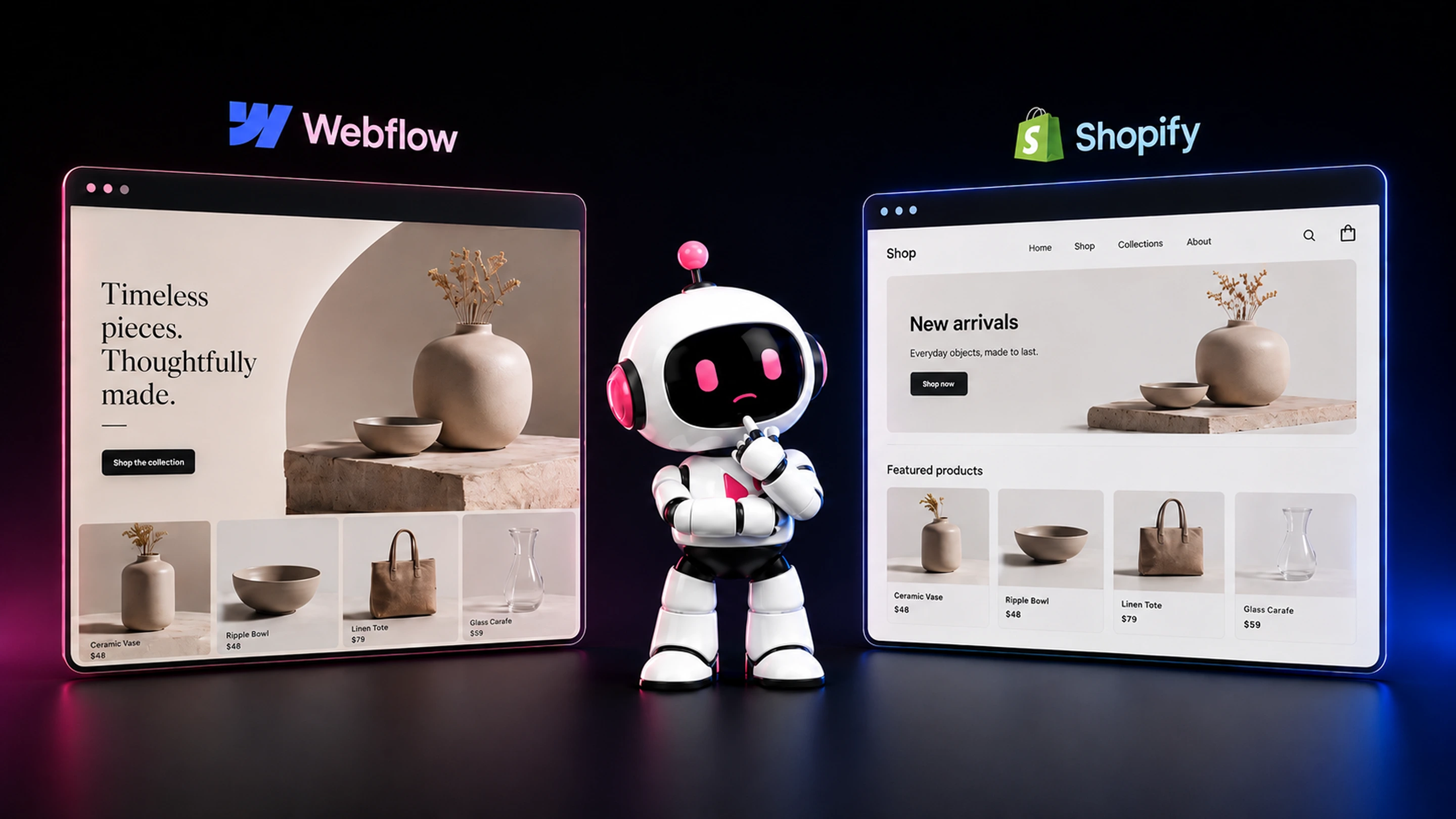
If you’re running a large catalog of thousands of products, complex inventory with intricate variants or warehousing, high-volume retail, dropshipping, or omnichannel operations spanning online and physical retail, a dedicated platform like Shopify or WooCommerce is the better fit. These platforms were built for commerce at scale, and they handle the logistics, automation, and product complexity that Webflow doesn’t. Choosing them over Webflow isn’t a knock on Webflow, it’s matching the tool to the job.
The hybrid option: Webflow + Shopify
There’s a third path that’s become increasingly popular in 2026, and it’s worth knowing about because it sidesteps the whole either/or choice.
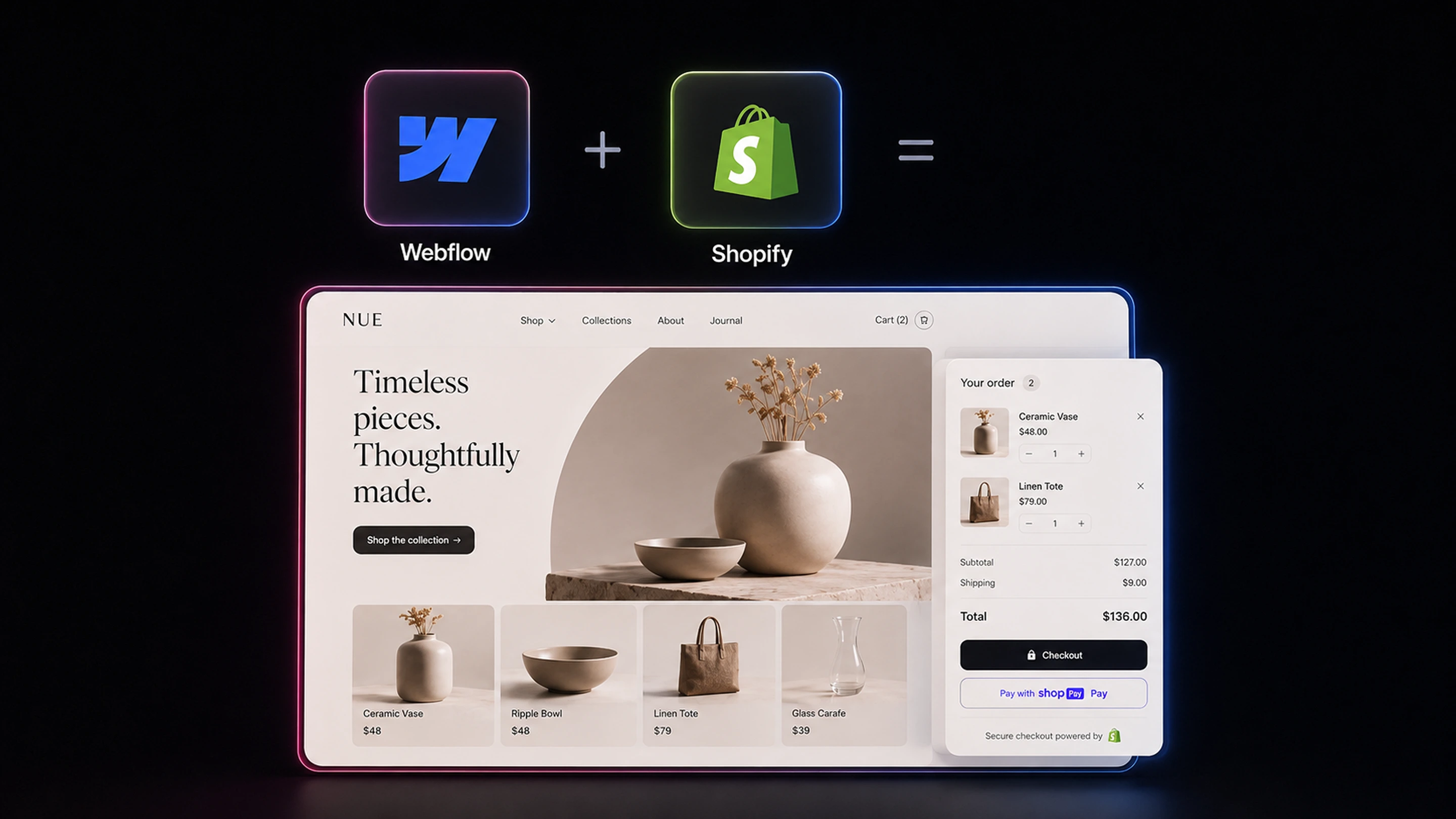
In a Webflow + Shopify hybrid, you use Webflow for everything it’s best at, the homepage, editorial and brand pages, blog, and CMS, and connect to Shopify for the checkout, payments, inventory, and fulfillment. You get Webflow’s design and content strengths on the front end with Shopify’s commerce engine underneath. For brands that want a genuinely custom brand experience but also need serious commerce infrastructure, this combination delivers the best of both, and it’s a common setup for design-led brands that have outgrown Webflow’s native commerce but don’t want to give up its front-end control.
The honest verdict
So, is Webflow good for ecommerce? Yes, for the right store. If you’re a design-led brand, sell digital products, run a small-to-mid catalog, or use commerce to support a content or B2B strategy, Webflow is genuinely strong, often stronger than a template-based platform, thanks to its design, speed, and SEO control. If you run a large or complex store, Shopify or WooCommerce will serve you better, and there’s no shame in choosing the tool built for that job. And if you want both a custom brand experience and serious commerce infrastructure, the Webflow plus Shopify hybrid is worth a look. The real question was never “is Webflow good for ecommerce” in the abstract. It’s “is Webflow good for my store,” and now you have what you need to answer it.

Frequently Asked Questions

Unlock the power
of
today